


You designed a strong board. But one weak supplier can stall your line, fail in the field, and cost you OEM trust overnight.
To choose a reliable automotive PCB manufacturer for bulk orders, verify IATF 16949 certification, confirm real automotive project experience, check reliability testing capability, review traceability systems, and demand transparent pricing. The right partner handles both prototype and mass production with consistent quality across every batch.
I have managed over 300 PCB projects across 20+ countries. I have seen good boards die from bad suppliers. Let me show you what really matters.
Definition of Automotive PCB vs Standard PCB
A consumer board failing is annoying. An automotive board failing can stop a car on a highway. The standards are not the same.
Automotive PCBs are built for absolute reliability under heat, vibration, and moisture, while standard PCBs follow lower-stress consumer requirements. Automotive boards use higher Tg materials, IPC Class 3 criteria, and heavy copper, and they must survive 15+ years of harsh driving conditions.
The gap between these two worlds explains why automotive sourcing is so demanding. Here is how it works in practice.
How Automotive PCBs Function in Vehicle Electronics
PCBs work as the nervous system of a vehicle. They let different electronic parts talk to each other and act in sync. Three main board types fill a car: single-layer, double-layer, and multi-layer boards. Most modern ECUs need at least a 4-layer or 6-layer stackup. Internal layers carry solid ground and power planes for EMI shielding and heat spread.
Automotive electronics have no single shared architecture. Each module is highly specialized and custom-built for one job. This is very different from standard consumer products. The move from gas engines to hybrid and pure EVs raised both the volume and complexity of these boards. EVs add high-voltage conversion needs like DC-DC converters and inverters, plus battery management systems. Assembly uses two main methods: Through-Hole Technology and Surface-Mount Technology. Each board must handle thermal cycling, vibration, and moisture while it carries high current or high-frequency signals at the same time.
Cost of PCB Failure in Automotive Electronics
A single PCB malfunction can range from a vehicle breakdown to a real safety hazard. That is the core reason automotive sourcing is so strict. A failed infotainment board frustrates a driver. A failed BMS or radar board can cause harm.
This is why automotive PCBs undergo accelerated life testing to simulate 15+ years of driving. The test cost is not waste, it is insurance against recalls. Let me show the rough impact of failure by stage in the table below.
| Failure Stage | Typical Cost Impact | Who Absorbs It |
|---|---|---|
| Caught in factory test | Lowest, scrap one board | Manufacturer |
| Caught in your assembly | Medium, line stops, rework | You |
| Caught after shipment | High, returns and audits | You + OEM |
| Field failure in vehicle | Highest, recall and safety risk | Whole supply chain |
A cheap supplier looks attractive until a field failure wipes out years of margin. I always tell clients to price risk, not just the board.
5 Critical Certifications a Reliable Automotive PCB Manufacturer Must Hold
Certificates do not guarantee good boards. But missing certificates almost always signal trouble. They are your first filter.
A reliable automotive PCB manufacturer must hold IATF 16949 as the core automotive quality standard, plus ISO 9001, ISO 14001, UL safety ratings, and must meet IPC Class 3 or IPC-6012DA acceptance criteria. These prove defect prevention, traceability, and process control.
Each certificate answers a different question about your supplier. Let me break them down one by one.
IATF 16949 Quality Management for Automotive PCB
IATF 16949 is the overarching quality management system standard for the automotive sector. Prioritize it above all others. Major OEM and Tier-1 supply chains require it before they approve any supplier. It focuses on defect prevention, traceability, and process control. It does not rely on simple final inspection.
A factory with live IATF 16949 has built systems for PPAP, PFMEA, Control Plans, and change management. These documents are often mandatory for OEM approval. At LZJPCB we earned IATF 16949 in 2023, and we use it to drive lot-level control across every automotive batch. When you audit a supplier, ask for the live certificate date. An expired one is worse than none, because it shows they let it lapse.
ISO 9001 and ISO 14001 Basics
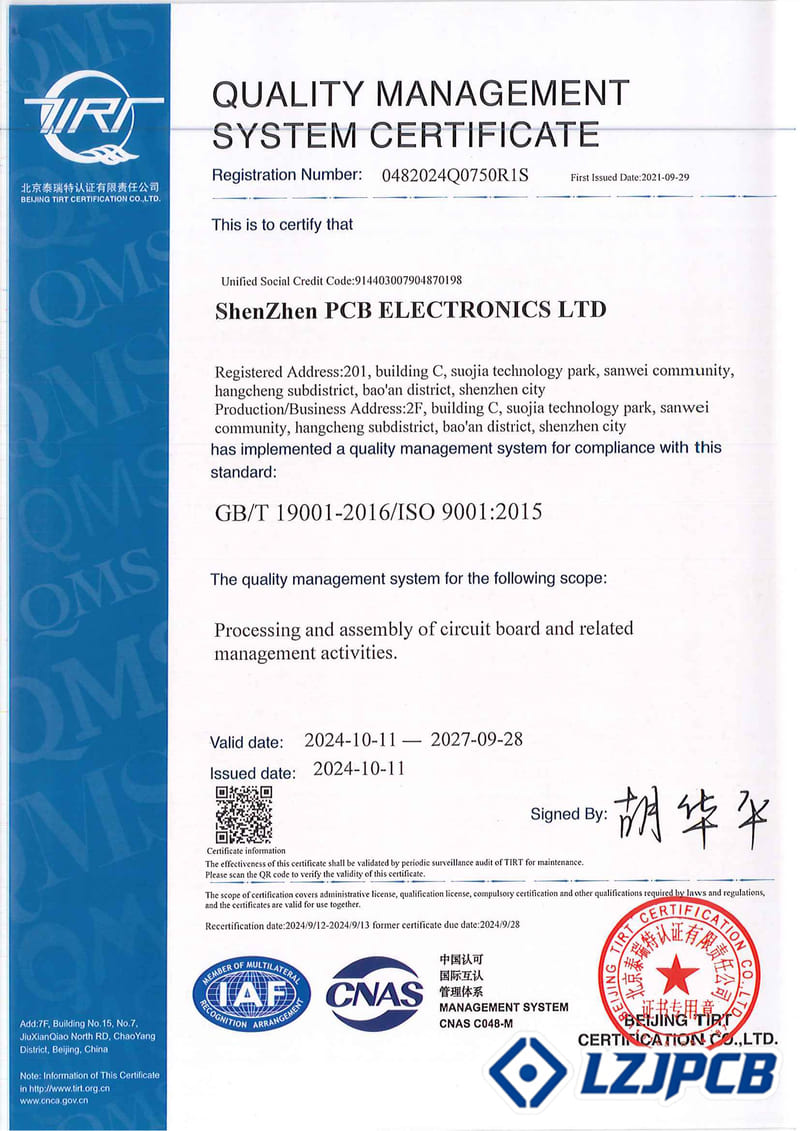
ISO 9001 is the base quality management standard. Think of it as the floor, not the ceiling. Any serious factory should hold it. It shows the plant has documented processes and reviews them. We earned ISO 9001 and ISO 14001 back in 2011.
ISO 14001 covers environmental management. It indicates a real commitment to sustainable practices in PCB production. For a German buyer selling globally, this matters for your own compliance story. Many of your end customers ask about supply chain environmental records. A supplier with ISO 14001 makes reporting easier for you. These two are necessary but not enough on their own. They do not prove automotive-grade discipline. You still need IATF 16949 on top. Treat ISO 9001 and 14001 as the entry ticket, then look deeper.
UL Flame Retardancy and PCB Safety Ratings
UL ratings prove the board resists fire and meets safety limits. In a vehicle, heat sources sit close to many boards. A non-flame-retardant board is a fire risk you cannot accept. UL and CUL marks confirm the laminate and finished board passed flammability tests.
We earned UL and CUL certification in 2012. For automotive work, this gives you traceable proof that the base material meets safety classes. The UL mark on the board also helps with your downstream certification when you sell finished automation gear. Always check that the UL file covers the exact material grade you ordered. Some suppliers hold UL for one laminate, then quietly swap to a cheaper one. Tie the UL claim to the material certificate for each lot. That link protects you in an audit.
IPC Class 2 vs Class 3 for Automotive Use
IPC Class 3 is the standard for high-reliability automotive electronics. Class 2 fits consumer goods where short failures are tolerable. Automotive safety boards cannot tolerate that. Confirm your supplier meets IPC-A-610 Class 3 and IPC-6012DA.
IPC-6012DA is the Automotive Applications Addendum. It defines acceptance criteria like minimum copper plating thickness and voiding limits. Here is the key difference for your boards.
| Criteria | IPC Class 2 | IPC Class 3 / 6012DA |
|---|---|---|
| Through-hole copper plating | Lower minimum | Minimum 25μm |
| Annular ring breakout | Some allowed | No breakout allowed |
| Internal voiding limits | Looser | Stricter |
| Target market | Consumer | Automotive, medical, aerospace |
For automotive bulk orders, always specify Class 3 in writing. Do not assume the factory defaults to it. State it on the purchase order and the fabrication notes.
How to Verify an Automotive PCB Manufacturer Production Capability
A nice brochure means nothing if the factory cannot build your stackup. Capability claims need proof. You must check the real numbers.
Verify production capability by checking maximum and minimum layer count, HDI and rigid-flex experience, SMT line specifications, and the gap between sample lead time and mass production lead time. Ask for real automotive case studies, not generic samples.
Capability splits into a few clear areas. Let me walk through each with the numbers you should request.
Layer Count Maximum and Minimum for Automotive PCB
Layer count tells you how complex a board the factory can build. Modern ECUs need at least 4 or 6 layers for solid ground and power planes. High-end ADAS and radar boards can need far more. Ask for both the prototype maximum and the mass production maximum, because they differ.
At LZJPCB, our manufacturing base handles 1–40 layers for prototypes and 1–32 layers for mass production. That range covers nearly every automotive need you have, from simple sensor boards to complex gateway controllers. Inside those layers, you also need vias done right. A buried via connects internal layers only. A blind via connects an outer layer to an internal layer. Microvias of 150μm or less connect adjacent layers without going through the whole board. Confirm the factory can run all three via types in mass production, not just on a one-off sample.
HDI and Rigid Flex PCB Production Experience
HDI and rigid-flex are where many cheap suppliers fail. HDI per IPC-2226 uses microvias with a diameter of 150μm or less. These connect adjacent copper layers without piercing the full board. Typical automotive HDI pushes track widths below 100μm and pad diameters below 250μm. Building this needs laser drilling and sequential build-up. Not every factory owns that gear.
Rigid-flex boards combine polyimide flexible substrates with rigid FR4. They allow 3D assembly in tight vehicle spaces. Steering column electronics, transmission sensors, and radar modules use rigid-flex to remove wire harnesses and connectors. That cuts weight and removes common mechanical failure points. Complex rigid-flex stackups can pass 20 layers and need precise impedance control. FPCs add an ultra-thin profile of 0.06mm to 0.3mm, with bending endurance as the main benefit. We run dedicated FPC and rigid-flex factories, so ask for matching case studies before you trust the claim.
SMT Assembly Line Specifications for Automotive Components
SMT line specs decide whether the factory can place your fine-pitch parts. Automotive PCB boards use tiny packages and dense BGAs. Ask for the minimum package size, placement accuracy, and daily capacity. Weak specs mean low yield and hidden defects.
Our PCBA lines place down to 01005 and 0.35mm pitch BGA. Placement accuracy reaches ±0.04mm for chip parts and ±0.03mm for ICs. Daily SMT capacity is 8 million placements. Here are the key SMT numbers to compare across suppliers.
| Spec | What to Ask | LZJPCB Capability |
|---|---|---|
| Min package | Smallest part placed | 01005 / 0.35mm BGA |
| Placement accuracy | IC and chip tolerance | ±0.03mm IC / ±0.04mm chip |
| PCB size range | Largest panel | 50×50mm to 774×710mm |
| Daily capacity | Placements per day | 8 million |
We run 3D SPI, inline AOI, and X-Ray, which I cover more below.
Sample Order Lead Time vs Mass Production Lead Time
Sample lead time and mass production lead time are two different things. Many buyers confuse them and plan incorrectly. A fast sample does not promise fast volume, and a slow sample does not always mean slow volume. Ask for both clearly.
Our prototype lead times run as fast as 12 hours for single and double-sided boards, 24 hours for 4-layer boards, and 48 hours for 6-layer expedited. PCBA samples can kit and run in 24 hours. Mass production timing depends on volume, layer count, and material grade. The key point for you is one consistent process from prototype to bulk. The best choice is a manufacturer that handles prototyping and bulk production within one workflow. That avoids the gap where a sample passes but the bulk batch drifts. We hold a 99%+ on-time delivery rate to keep your line fed.
6 Quality Tests That Separate Reliable Automotive PCB Manufacturers
Any factory can pass a board at room temperature. The real test is what happens at -40℃ in a vibrating engine bay. That is where weak suppliers break.
Six tests separate reliable automotive PCB manufacturers: thermal cycling, vibration and shock, humidity and salt spray, electrical continuity and insulation, X-ray inspection, and cross-sectioning. These checks expose hidden defects before boards reach the vehicle and the field.
Each test targets a specific failure mode. Let me explain what each one catches and why it matters for your boards.
Thermal Cycling Test for Extreme Temperature Performance
The Thermal Cycling Test cycles boards between -40℃ and +125℃, or up to +150℃ for under-hood use. This exposes CTE mismatches between copper vias and the dielectric substrate. Those mismatches precipitate microvia cracking and solder joint fatigue. A board can pass once at room temperature, then crack after a thousand cold-to-hot swings.
This test matters most for your industrial automation gear that sees wide temperature swings. A microvia crack often hides until the field. Then it fails intermittently and is nearly impossible to debug remotely. I always push automotive clients to require TCT data on real production boards, not just on a design qualification sample. Ask for the cycle count and the temperature range used. A factory confident in its plating and lamination will share this gladly. One that dodges the question is hiding a weak process.
Vibration and Mechanical Shock Test Standards
Vibration and mechanical shock tests check that the board and its joints survive constant motion. A vehicle shakes every second it runs. Solder joints, connectors, and heavy components feel that stress for years. A board that looks perfect can crack a joint after months of road vibration.
Rigid-flex structures help here. They remove wire harnesses and mechanical connectors, which cut common points of mechanical failure. That is one reason radar and steering modules use rigid-flex. For your sourcing, ask the supplier how they test for vibration and what fixtures they use. Heavy parts like large capacitors and transformers need staking or underfill to survive shock. A good DFM review flags these risks before production. We run manufacturability reviews early and recommend mechanical reinforcement where the design needs it. This step saves you from field returns that are slow and costly to trace.
Humidity and Salt Spray Corrosion Testing
Humidity and salt spray tests check corrosion resistance. Cars meet rain, road salt, and washes. Moisture and salt attack exposed copper and weak finishes. A corroded trace can open a circuit years after delivery. The Temperature-Humidity Bias test applies continuous electrical bias under 85℃ and 85% relative humidity.
This THB test identifies electrochemical migration, also called CAF, plus moisture absorption and dendritic growth between closely spaced traces. CAF resistance validation is a must for harsh automotive environments. Closely spaced traces are most at risk, and automotive HDI boards run very tight spacing. For your boards that ship to many climates, ask for CAF test results and salt spray data on the chosen surface finish. The finish choice drives this, which I cover in the materials section. A supplier without humidity testing gear cannot promise corrosion life. That is a real red flag for long-term automotive supply.
Electrical Continuity and Insulation Resistance Checks
Electrical continuity and insulation resistance checks confirm the board is wired exactly as designed. Continuity testing finds opens and shorts. Insulation resistance testing confirms isolation between nets that must stay apart. These are the most basic tests, yet some cheap suppliers skip full coverage to save time.
We run 100% electrical test plus AOI dual inspection on every board. Two common methods catch defects in assembly: Automated Optical Inspection and In-Circuit Testing. AOI scans for visual defects like missing parts and bad joints. ICT powers the board and checks each net electrically. For your bulk orders, demand 100% electrical test, not sampling. A 99% sample pass still ships defective boards in large volumes. Ask the supplier to confirm test coverage in writing on the quote. If a factory has no in-house electrical testing equipment, walk away. That is a clear sign of weak quality control.
X Ray Inspection for Hidden Solder Joint Defects
X-ray inspection finds defects you cannot see with your eyes. BGA and bottom-terminated parts hide their joints under the package, AOI cannot see those joints. X-ray looks through the part to check for voids, bridges, and open joints. Automotive boards use many BGAs, so X-ray is not optional.
We run inline X-Ray on our PCBA lines for exactly this reason. A voided BGA joint can pass continuity at first, then fail under thermal cycling. That is the worst kind of defect, because it ships and then dies in the field. For your high-reliability boards, ask the supplier if X-ray is standard or extra. With us it is built into the process. Also ask for void percentage limits, because IPC Class 3 sets strict voiding rules. A clear void limit on the quote protects you. No X-ray capability means hidden joint defects reach your customers.
Cross-Sectioning for Internal Layer Verification
Cross-sectioning is destructive but powerful. The lab cuts a board, polishes the edge, and looks at the internal layers under a microscope. This confirms layer registration, copper plating thickness, and via quality. It is the only way to verify what is inside a finished multilayer board.
IPC-6012DA sets minimum through-hole copper plating at 25μm with strict void limits. Cross-sectioning proves the factory actually met that. For your automotive bulk orders, ask the supplier to provide cross-section reports per batch or per qualification. This catches plating thinning and lamination voids that no surface test can see. We use cross-sectioning to validate our HDI and high-layer boards, including any-layer interconnection builds. The report should show the measured plating values against the spec. A factory that shares clear cross-section data has nothing to hide. One that refuses is asking you to trust blindly.
Key Material Parameters for High-Reliability Automotive PCB
The wrong material turns a perfect design into a field failure. Automotive heat and current break standard laminates fast. Material choice is not a place to save money.
Key automotive material parameters are Tg value above the standard FR4 130℃, CTE matched to surface-mount components, copper weight sized for power and signal needs, and a surface finish chosen for corrosion resistance. These drive long-term reliability in harsh vehicle conditions.
Material engineering decides if your board survives 15 years or fails in two. Here are the four parameters that matter most.
TG Value Minimum for Automotive PCB Substrates
Tg is the glass transition temperature. Above it, the laminate softens and loses dimensional stability. Standard FR4 has a Tg around 130℃. Automotive operating limits often exceed this. That forces advanced substrate engineering. A board built on low-Tg material under engine heat will warp and crack.
For automotive work, I push clients toward High-Tg FR4 or better. We stock High TG, Rogers, polyimide, halogen-free, and metal core materials. The right Tg depends on where the board sits in the vehicle. Under-hood and powertrain boards need higher Tg than cabin electronics. Ask your supplier to match the Tg to your thermal profile, not just to a default FR4. Material certs should show the exact Tg and be traceable to a known maker like Shengyi or Isola. We use A-grade laminates with UL and RoHS traceability, so you always know what is inside your board.
CTE Matching for Surface Mount Component Longevity
CTE is the coefficient of thermal expansion. It measures how much a material grows when heated. The problem comes when the board and the component expand at different rates. That mismatch stresses solder joints during every thermal cycle. Over time it cracks joints and kills the part.
This is why ceramic substrates matter for high-power parts. Ceramic substrates like Alumina and Aluminum Nitride offer a CTE that closely matches bare semiconductor dies. They serve high-power IGBT modules and bare-die wire bonding. For standard surface-mount parts, low-CTE laminates reduce joint stress and extend life. The thermal cycling test I described above is exactly what exposes CTE mismatch. For your boards, ask the supplier about low-CTE laminate options for parts that run hot. We can build with ceramic and low-CTE materials where your design needs them. Matching CTE early prevents the slow joint fatigue that causes field failures years later.
Copper Weight Options for Power and Signal Layers
Copper weight sets how much current a layer can carry. Signal layers use light copper, power layers in EVs need much more. Heavy copper PCBs for EV powertrains, DC-DC converters, and BMS units range from 3oz to 10oz and beyond. This manages extreme current loads without thermal runaway.
Etching thick copper is harder than it looks. Etching a 50μm foil induces a trapezoidal cross-section from lateral etching. That gives a larger width tolerance than a standard 18μm foil. It demands specific DFM compensation rules. A factory without heavy copper experience will get trace widths wrong. Power traces must also be sized for continuous current at a set temperature rise, usually 10℃ or 20℃. We build up to 12oz copper and run the DFM rules to keep widths in tolerance. For your power boards, give the supplier your current and temperature-rise targets so they size the copper correctly.
Surface Finish Comparison for Automotive Environments
Surface finish protects the copper pads and sets solderability. The wrong finish corrodes in humid or salty conditions. The salt spray test I covered earlier targets exactly this. For automotive boards, ENIG is a common choice for its flat surface and corrosion resistance. Here is a quick comparison of the finishes we offer.
| Surface Finish | Corrosion Resistance | Best Automotive Use |
|---|---|---|
| HASL / Lead-free HASL | Moderate | Lower-cost, larger pads |
| ENIG | High | Fine pitch, harsh environments |
| Immersion silver | Medium | High-frequency signals |
| Immersion tin | Medium | Fine pitch, flat surface |
| ENEPIG | Very high | Mixed bonding, high reliability |
For boards facing moisture and salt, I recommend ENIG or ENEPIG. They resist corrosion far better than bare HASL. We offer all these finishes plus gold fingers and OSP combinations. Match the finish to the environment, not to the lowest price.
Bulk Order Costs for Automotive PCBs: What You Actually Pay For
A low quote feels like a win until hidden costs appear later. Automotive PCB pricing has many parts, You need to know what each one buys.
Bulk automotive PCB costs break into MOQ commitments, setup and tooling fees, unit price driven by layer count and material grade, and hidden risks from cheap suppliers. Analyze cost against quality and service, never as the sole deciding factor.
Understanding the cost structure protects your margin. Let me break down each piece so you can read any quote clearly.
MOQ Expectations for Custom Automotive PCBs
MOQ is the minimum order quantity. Many factories set a high MOQ for custom automotive boards because setup is costly. This blocks small validation runs. For your model, you need flexibility to serve different markets at different volumes. A rigid MOQ kills that flexibility.
We support prototyping with no minimum order quantity on the component side, and we scale smoothly into volume. That lets you validate a design with a small run, then ramp to bulk on the same process. Define your volume needs up front. Volume splits into prototype, low-volume, and high-volume production. Tell the supplier which stage you are in and where you are heading. A good partner quotes a path from prototype to mass production, not a single fixed batch. That path avoids re-qualifying a new factory when you scale. Always confirm the MOQ in writing before you commit.
Setup Cost and Tooling Fee Breakdown
Setup and tooling fees are one-time charges to prepare your board for production. They cover stencils, test fixtures, and program setup. These fees spread across the order. On a small run they hit hard per unit. On a large run they nearly disappear per unit. This is why unit price drops as volume rises.
For your bulk orders, ask the supplier to list tooling fees separately from unit price. A clear breakdown lets you compare quotes fairly. Some suppliers hide tooling inside a low unit price, then surprise you on the first reorder. Others quote a fair tooling fee once and keep your data for future runs. We keep your tooling and program data so reorders skip repeat setup costs. Ask whether tooling is one-time or charged each batch. That single question reveals a lot about how a supplier treats long-term partners.
Unit Price Factors by Layer Count and Material Grade
Unit price rises with layer count and material grade. More layers mean more process steps, more lamination, and more test. Premium materials like Rogers, polyimide, and ceramic cost far more than standard FR4. Heavy copper adds cost too. So a quote depends heavily on your stackup and material choice.
Here are the main drivers that move unit price.
| Factor | Lower Cost | Higher Cost |
|---|---|---|
| Layer count | 2–4 layers | 14+ layers |
| Material | Standard FR4 | Rogers, ceramic, polyimide |
| Copper weight | 1–2oz | 3–10oz+ |
| Surface finish | HASL | ENIG, ENEPIG |
| Tolerances | Standard | Tight impedance, fine pitch |
For your boards, do not over-spec where you do not need it. A good DFM review can suggest where to relax a parameter without hurting reliability. We do this to raise yield and lower your cost. Match the spec to the function, then the price follows.
Hidden Cost Risks with Low Price Automotive PCB Suppliers
A very low price often hides future costs. The cost of assembly should be analyzed against quality and service, not taken as the sole deciding factor. A cheap supplier may skip full electrical test, use ungraded laminate, or swap finishes. Those shortcuts surface later as field failures.
The hidden costs are real and large. They include scrap, line stops, rework, returns, and lost OEM trust. For your industrial automation products sold globally, one batch of bad boards can damage relationships you spent years building. I have seen buyers save 10% on the board and lose far more on a recall. Ask any low-price supplier hard questions about test coverage, material grade, and traceability. If the answers are vague, the low price is paying for risk you will absorb. A fair price from a disciplined factory is almost always the cheaper choice over a product lifecycle.
Red Flags When Evaluating Automotive PCB Manufacturers for Long-Term Supply
Automotive products live 10 to 20 years. Your supplier must last that long with consistent quality. Some warning signs tell you a partnership will fail early.
The main red flags are missing or expired IATF 16949 certification, no in-house electrical testing equipment, an unclear component traceability policy, and vague warranty terms for field failures. Any one of these signals high risk for long-term automotive supply.
Spotting these flags early saves you from a painful supplier switch later. Here are the four to watch most closely.
Missing or Expired IATF 16949 Certification
A missing or expired IATF 16949 certificate is the biggest red flag. It is the global automotive quality standard required by major OEM supply chains. No certificate means the factory has not built the systems for defect prevention and process control. An expired one means they let critical discipline lapse.
Always check the certificate date during your audit. Ask to see the live document, not a screenshot from years ago. A serious automotive factory renews on schedule and shares proof without hesitation. We hold current IATF 16949, earned in 2023, and we run lot-level control under it. If a supplier cannot show a valid certificate, they cannot support OEM-grade work. For your long-term supply, this is a hard pass. The certificate is not paperwork. It is proof the factory thinks in automotive terms every day.
No In House Electrical Testing Equipment
A factory with no in-house electrical testing equipment cannot guarantee quality. If they outsource testing, they lose control of coverage and speed. Worse, some skip full testing to cut cost. For automotive bulk orders, you need 100% electrical test on every board, not a sample.
Ask to see the test equipment during an audit. Look for flying probe or fixture testers, AOI, and X-ray. We run 100% electrical test plus AOI dual inspection, with inline X-Ray on PCBA. A factory that owns its test gear controls its own quality. One that sends boards out for testing adds delay and risk. This matters for your tight lead times too. In-house testing keeps the loop fast and the data traceable. If a supplier cannot show their test floor, treat it as a serious warning sign for long-term work.
Unclear Component Traceability Policy
Traceability is non-negotiable for automotive. A reliable manufacturer provides lot-level tracking of materials, processes, inspections, and operators. This supports recalls, audits, and root-cause investigations. A vague traceability policy means the factory cannot tell you what went into your board. That is unacceptable when a recall hits.
For components, ask about the sourcing channel. We source from original manufacturers and tier-1 agents, with 100% genuine and traceable parts. We run IQC incoming inspection and store parts under FIFO, ESD-safe, temperature and humidity control. Ask any supplier how they trace a single board back to its material lots and operators. If they cannot, you have no defense in an audit. For your global B2B sales, traceability protects you and your customers. A factory with clear lot-level tracking is built for serious automotive work. A vague answer is a red flag you cannot ignore.
Vague Warranty Terms for Field Failures
Vague warranty terms hide future arguments. A field failure in automotive is costly and stressful. You need to know exactly what the supplier covers and for how long. If the terms are unclear, you will fight over every failure. That damages a long-term partnership fast.
Get warranty terms in writing before you order. Ask what counts as a covered defect, how long coverage lasts, and how returns are handled. A confident factory states clear terms because it trusts its process. Strong documentation backs this up. Ask for SPC reports, material certifications, and change management records. These prove the factory controls its quality and can defend its work. We support PPAP, PFMEA, Control Plans, and SPC reporting, which OEM and Tier-1 approval often require. Clear warranty terms plus solid documentation mean the supplier stands behind every board. Vague terms mean you carry all the risk alone.
Frequently Asked Questions About Choosing an Automotive PCB Manufacturer
Common questions cover warranty length, whether one manufacturer handles both prototype and mass production, typical first article inspection lead time, and how to request a supplier audit. The best partner answers all four clearly and in writing.
These are the questions my clients ask most before they place a first order. Here are direct answers.
How Long Does a Reliable Automotive PCB Manufacturer Warranty Last
A reliable automotive PCB warranty should align with the automotive product lifecycle, which often runs 10 to 20 years. The exact term depends on the contract and the application. What matters more than a single number is clear written coverage. The terms should define a covered defect, the period, and the return process.
Automotive boards undergo accelerated life testing to simulate 15+ years of driving. A factory confident in that testing can offer firm warranty terms. Ask the supplier to state warranty length in the contract, not just in conversation. For long-term supply, also ask about production stability over that lifecycle. The supplier must support controlled engineering changes and consistent quality across many batches. A vague warranty signals risk. A clear one, backed by SPC and traceability data, signals a partner ready for the long automotive life.
Can One Manufacturer Handle Both Prototype and Mass Production
Yes, and choosing one that does is usually the best move. The best choice is a manufacturer that handles prototyping and bulk production within one consistent process. This avoids the gap where a board passes as a prototype but drifts when a different factory runs the volume. One process means one set of rules from start to scale.
We support the full path from prototype validation to mass production under one roof. Our prototype lead times run as fast as 12 to 48 hours, and we scale into volume on the same lines and data. For you, this removes the pain of re-qualifying a new factory when you ramp. It keeps your tooling, your test data, and your quality records in one place. Ask any supplier if they own both prototype and mass production capability. A single consistent partner lowers your risk across the whole project.
What Is the Typical Lead Time for First Article Inspection
First article inspection lead time depends on board complexity, but a strong factory completes it within days, not weeks. First article inspection confirms the first production unit matches the design and the documentation before volume runs. It catches errors early, before they multiply across a bulk order.
We run intelligent first-article inspection on our PCBA lines as a built-in step. For your orders, ask the supplier how long FAI takes and what report you receive. The report should compare measured results against your spec. A fast, documented FAI shows a disciplined process. A slow or vague one signals weak control. Tie FAI to your launch schedule so you plan correctly. For automotive work, never skip FAI to save time. A small delay here prevents a large defect run later, which protects both your timeline and your margin.
How to Request a Supplier Audit Before Placing Orders
Request a supplier audit by sending a written audit plan that lists what you want to see. Cover certifications, test equipment, traceability systems, and documentation like PPAP and Control Plans. A serious automotive factory welcomes this. One that resists is hiding something.
Start by defining your exact needs: board size, complexity, volume, and production stage. Then ask the supplier to confirm matching capability and certifications. Request the live IATF 16949 certificate, a tour of the test floor, and sample traceability records. Ask to see real automotive case studies for EV BMS, ADAS, ECUs, or safety electronics. We welcome audits and can show our automotive experience, turnkey PCBA capability, quality systems, and traceability processes. You can audit in person or by video and document review. A clear audit before ordering protects your long-term supply and confirms the partner fits your standards.
Conclusion
Choose an automotive PCB partner by IATF 16949, real automotive experience, full testing, traceability, and transparent pricing. One consistent factory from prototype to bulk lowers your risk.