

You search for a reliable medical device partner. The list looks endless. Picking the wrong one risks quality, delays, and lost trust.
The top 20 medical device manufacturers by revenue include Medtronic, Abbott, Siemens Healthineers, Stryker, GE HealthCare, Philips, Boston Scientific and Baxter. These leaders dominate cardiac, imaging, surgical, and diagnostic device markets worldwide.
I am Jayden, a senior engineer at LZJPCB. I have managed over 300 PCB projects for medical clients. Let me show you who leads this market and how to pick the right partner.
Complete List of the Top 20 Medical Device Manufacturers by Revenue
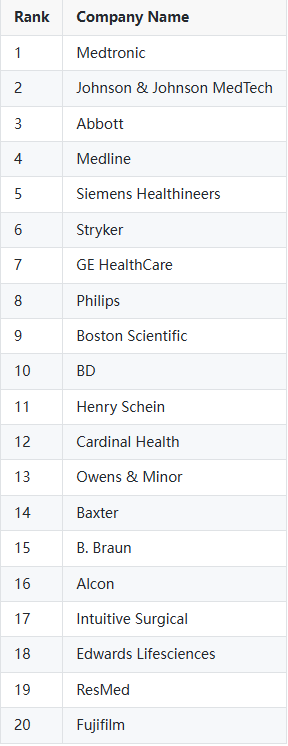
You need names you can trust. A wrong shortlist wastes weeks. Here is the verified list ranked by revenue.
| Rank | Company Name |
|---|---|
| 1 | Medtronic |
| 2 | Johnson & Johnson MedTech |
| 3 | Abbott |
| 4 | Medline |
| 5 | Siemens Healthineers |
| 6 | Stryker |
| 7 | GE HealthCare |
| 8 | Philips |
| 9 | Boston Scientific |
| 10 | BD |
| 11 | Henry Schein |
| 12 | Cardinal Health |
| 13 | Owens & Minor |
| 14 | Baxter |
| 15 | B. Braun |
| 16 | Alcon |
| 17 | Intuitive Surgical |
| 18 | Edwards Lifesciences |
| 19 | ResMed |
| 20 | Fujifilm |
I work with many of these brands as suppliers and clients. Let me break down the numbers behind the list.
Year-Over-Year Revenue Change for Each of the Top 20 Medical Device Manufacturers
The list moves every year. Some firms climb fast, others slip down. I track these shifts because they tell me where the market is heading.
Recent data shows clear movement. Siemens Healthineers moved from rank 4 to rank 3 and passed Stryker. GE HealthCare moved from rank 7 to rank 6 and passed Royal Philips. Boston Scientific jumped from rank 11 to rank 9 and entered the top 10. Cardinal Health’s medical segment dropped from rank 9 to rank 12.
| Company | Move | Note |
|---|---|---|
| Siemens Healthineers | 4 → 3 | Overtook Stryker |
| GE HealthCare | 7 → 6 | Overtook Philips |
| Boston Scientific | 11 → 9 | Entered top 10 |
| Cardinal Health | 9 → 12 | Medical segment dropped |
Big changes are coming. Medtronic plans to separate its diabetes business, which makes about $2.8 billion a year. After that split, Johnson & Johnson MedTech is set to become the world’s largest medical device company. The revenue gap between the #1 and #2 firms is small at $1.68 billion. These shifts prove the list is never fixed.
Global Market Share Criteria Used by Industry Analysts
Analysts do not rank by guess. They use clear rules. I check these rules before I trust any list.
Most rankings use annual revenue reported in U.S. dollars. This matters because firms like Siemens Healthineers and Philips earn in many currencies. Currency swings can change their rank year to year.
Analysts also set revenue thresholds. The minimum to enter the top 10 is around $15.054 billion (BD). The top 50 needs $2.382 billion (ICU Medical). The top 100 needs $167.178 million (Si-Bone). The 50th firm earns about 14.25 times more than the 100th firm. That shows how steep the curve is.
Good rankings also exclude pure distribution, PPE, and software firms. They count only real devices and supply makers. Most analysts pull data from Capital IQ, Yahoo Finance, and multpl.com. No single official list exists. So I always cross-check more than one source.
Product Portfolio Breadth Across Therapeutic Areas
Breadth matters. A wide portfolio means stable supply. A narrow one means deep skill. I weigh both when I judge a maker.
The leaders cover many areas. Medtronic makes cardiac, diabetes, neurological, and surgical products. Johnson & Johnson MedTech covers orthopedics, surgery, and cardiovascular. Abbott handles cardiovascular, diabetes care, diagnostics, and neuromodulation. These firms spread risk across segments.
| Company | Main Areas |
|---|---|
| Medtronic | Cardiac, diabetes, neuro, surgical |
| J&J MedTech | Orthopedics, surgery, cardiovascular |
| Abbott | Cardiovascular, diabetes, diagnostics |
| Siemens Healthineers | Imaging, diagnostics, lab |
| Stryker | Orthopedics, surgical, neurotech |
The market shows a fragmented top. The top four firms each lead a different primary segment, yet all earn over $27 billion. Some firms stay narrow on purpose. Intuitive Surgical focuses only on robotic surgery. ResMed focuses on sleep and respiratory care. Both rank high with one strong area. So breadth is not always better. It depends on what you need.
How to Verify a Medical Device Manufacturer Legitimately Qualifies for the Top 20
Some firms claim a rank they do not hold. A false claim can fool a busy buyer. You must verify before you trust.
Verify a top 20 ranking by cross-checking three independent data sources, reading audited annual reports instead of press releases, and watching for red flags like vague figures or unverified claims. Real leaders publish clear, traceable numbers.
I do this check for every supplier I bring on. Let me show you my method step by step.
3 Independent Data Sources to Cross-Check Manufacturer Rankings
One source is never enough. A single report can be old or wrong. I always use three.
First, I use financial databases like Capital IQ. These pull audited filings and give clean revenue data. Second, I use public market sites like Yahoo Finance. These show market cap, P/E ratios, and recent changes. Third, I use industry reports such as the Medtech Big 100. This report holds thousands of data points beyond revenue, like R&D spend, headcount, CEO names, and headquarters.
| Source Type | Example | What It Shows |
|---|---|---|
| Financial database | Capital IQ | Audited revenue |
| Market site | Yahoo Finance | Market cap, P/E |
| Industry report | Medtech Big 100 | Full company profile |
When all three agree, I trust the rank. When they conflict, I dig deeper. This simple habit has saved me from bad data many times. It also helps me spot which firms are rising and which are slipping.
Red Flags That Indicate a Manufacturer Is Inflating Its Market Position
Some firms talk big, but the numbers tell the truth. I learned to spot the warning signs early.
The first red flag is vague revenue. A real leader gives exact figures. A weak claim uses words like "one of the largest" with no number. The second red flag is mixing total corporate revenue with device revenue. For example, Johnson & Johnson’s MedTech segment reports about $34 billion, not its full $85 billion corporate revenue. A firm that blurs this line inflates its size.
The third red flag is missing audit data. If a firm cannot show audited filings, I stay away. The fourth is reliance on press releases alone. Press releases sell a story. They are not verified. The fifth is no traceable source. If I cannot trace the claim back to a filing or a known database, I treat it as marketing. These checks keep me honest and protect my clients from false promises.
Why Annual Reports Are More Reliable Than Press Releases for Ranking Data
A press release wants to impress you. An annual report must tell the truth by law. The difference is huge.
Annual reports are audited. Independent firms check every number. This makes them hard to fake. They follow strict accounting rules. So when I read a top 20 claim, I go straight to the annual report. It shows segment revenue, net earnings, and growth over time.
Press releases skip the hard parts. They highlight wins and hide losses. They may quote a peak quarter, not a full year. They rarely show the source of a ranking. I have seen firms call themselves "top tier" in a release while their filings showed a drop.
For ranking data, I trust the document that carries legal weight. The annual report carries that weight. It is slower to read. It is far more reliable. This rule has never failed me in seven years of sourcing.
Medical Device Manufacturer Specialization vs Diversification in the Top 20
Should you pick a giant or a specialist? Both have strengths. The wrong choice can hurt quality or supply.
Top 20 manufacturers split between diversified giants like Medtronic and Abbott, which cover many areas, and focused specialists like Intuitive Surgical and ResMed. Diversification gives supply stability, while specialization gives deep expertise in one device category.
I see this trade-off in every project. Let me explain where the top firms focus and what it means for you.
5 Therapeutic Areas Where Top 20 Medical Device Manufacturers Concentrate
The top firms cluster in a few key areas, these areas hold the most revenue. I track them to know where demand sits.
The five main areas are cardiovascular, orthopedics, imaging and diagnostics, diabetes care, and surgical systems. Cardiovascular leads with players like Medtronic, Boston Scientific, and Edwards Lifesciences. Orthopedics holds Stryker, Zimmer Biomet, and Globus Medical. Imaging holds Siemens Healthineers, GE HealthCare, and Philips.
| Therapeutic Area | Key Players |
|---|---|
| Cardiovascular | Medtronic, Boston Scientific, Edwards |
| Orthopedics | Stryker, Zimmer Biomet, Globus |
| Imaging/Diagnostics | Siemens, GE, Philips, Fujifilm |
| Diabetes Care | Medtronic, Abbott, Dexcom, Insulet |
| Surgical Systems | J&J MedTech, Intuitive Surgical |
The diabetes market is crowded. Four firms in the top 40 focus on it: Medtronic, Abbott, Dexcom, and Insulet. This shows that one area can support many big players. When I source electronics for a client, I match my work to their target area. That focus keeps quality high.
Diversified Manufacturers vs Niche Specialists Below the Top 20
Below the top 20, the picture changes. Niche firms rise fast. They win by going deep, not wide.
Diversified giants spread across many areas. This protects them when one market dips. But it can slow their focus on a small product. Niche specialists do the opposite. Straumann leads pure-play dental implants. Sonova and Demant focus only on hearing aids, with similar P/E ratios of 24 and 27 despite a revenue gap.
These specialists often grow faster. Globus Medical, smaller than Zimmer Biomet, carries a higher P/E of 28 versus 21. The market expects more growth from the focused player. This pattern repeats across the list. A small firm with one strong skill can beat a giant in that one area. For buyers, this means the best partner may not be the biggest name. It may be the firm that knows your exact product best.
How Specialization Affects Supplier Reliability for Your Product Category
A specialist knows your product deeply. A giant knows many products broadly. Reliability depends on the match. I judge this for each client.
A focused supplier brings deep process knowledge. They have solved your exact problems before. This cuts errors and speeds delivery. For a niche device, this depth matters more than size. But a niche firm may have limited capacity. One big order can stretch them thin.
A diversified supplier brings scale and backup. If one line fails, they shift work. This gives steady supply for large volumes. But they may treat a small order as low priority. So your order can wait.
At LZJPCB, I see this daily. We support medical clients with PCB and PCBA work. We act like a specialist for electronics, but keep the scale to flex. I match the right capacity to each project. The lesson is simple. Pick the supplier whose strengths fit your product class and volume. Do not pick on brand size alone.
Quality Certifications Carried by All Top 20 Medical Device Manufacturers
A missing certificate can halt your whole supply chain. Regulators do not forgive, you must confirm every credential.
All top 20 medical device manufacturers carry ISO 13485 certification, FDA establishment registration, and EU MDR compliance. Many also hold MDSAP and country-specific certificates. These prove a controlled quality system that meets global regulatory demands.
OEMs prioritize three credentials: ISO 13485, FDA registration, and documented quality systems. Let me explain each one and why it matters.
ISO 13485 and MDSAP Compliance Across the Top 20
ISO 13485 is the base standard. Without it, you cannot supply medical devices at scale. Every top 20 firm holds it, so do we at LZJPCB.
ISO 13485 sets the rules for a medical quality management system. It covers design, production, and traceability. It forces a firm to document every step. This builds trust and cuts risk.
MDSAP goes further. It stands for Medical Device Single Audit Program. One MDSAP audit covers five markets: the U.S., Canada, Brazil, Japan, and Australia. This saves time and avoids repeat audits.
| Certification | Scope | Why It Matters |
|---|---|---|
| ISO 13485 | Quality system | Base requirement for medical supply |
| MDSAP | 5 markets in one audit | Cuts audit time and cost |
For a buyer, these two prove a firm can run a controlled process. When I work with medical clients, I show our ISO 13485 first. It opens the door. MDSAP then proves we can serve many markets at once.
FDA Establishment Registration and EU MDR Certifications
The U.S. and EU are the two biggest markets. Each has its own gatekeeper. You must clear both to sell widely.
FDA establishment registration lists a firm with the U.S. Food and Drug Administration. It means the FDA knows the facility and can audit it. For any device sold in the U.S., this is a must. Every top 20 firm holds it.
EU MDR is the European Medical Device Regulation. It replaced the older MDD rules. MDR is stricter on safety and clinical data. It demands full traceability and post-market checks. A firm without MDR cannot sell new devices in Europe.
My client Michael in Germany cares most about MDR. His firm sells across the EU. So I confirm MDR readiness in our supply chain before any deal. These two credentials together cover the largest device markets on earth. A real top 20 firm carries both without question.
6 Additional Country-Specific Certificates Held by Top Manufacturers
Global sales need local approval, each country adds its own stamp. The top firms collect them all.
Here are six common country-specific certificates. First, Health Canada licensing for the Canadian market. Second, Japan’s PMDA approval. Third, China’s NMPA registration. Fourth, Brazil’s ANVISA approval. Fifth, Australia’s TGA listing. Sixth, the UK’s UKCA mark after Brexit.
| Certificate | Country/Region |
|---|---|
| Health Canada | Canada |
| PMDA | Japan |
| NMPA | China |
| ANVISA | Brazil |
| TGA | Australia |
| UKCA | United Kingdom |
Each one demands its own paperwork and audits. The top 20 firms keep teams just to manage these. This is why they sell in so many places. For my clients, I align our certifications with their target markets. If they sell in Japan, I confirm the right path. The more certificates a firm holds, the wider its legal reach. This breadth is a clear sign of a true global leader.
How to Compare Top 20 Medical Device Manufacturers for Supplier Selection
Revenue alone does not pick a partner. A big name can still fail your needs. You need a real comparison method.
Compare top 20 manufacturers using seven criteria beyond revenue: certifications, engineering support, facility capabilities, quality systems, lead times, minimum order quantity, and production scalability. Send a structured request for information to score each supplier fairly.
I use this exact process for every sourcing decision. Let me walk you through my criteria and tools.
7 Selection Criteria Beyond Revenue and Brand Recognition
Brand fame is a weak guide. A famous firm can ignore a small order. I score suppliers on seven real factors.
OEMs review eight criteria when they pick a partner: certifications, case studies, quality systems, engineering support, facility capabilities, operational maturity, production experience, and scalability. From these, I built my core seven for daily use.
| # | Criterion | What I Check |
|---|---|---|
| 1 | Certifications | ISO 13485, FDA, MDR |
| 2 | Engineering support | DFM, design help |
| 3 | Facility capabilities | Cleanroom, equipment |
| 4 | Quality systems | Traceability, inspection |
| 5 | Lead time | Speed and reliability |
| 6 | MOQ | Prototype flexibility |
| 7 | Scalability | Volume growth |
Engineering support stands out for me. At LZJPCB, we give clients dedicated engineers for custom work. Most competitors use website order forms with no one-on-one help. This support cuts errors and speeds the build. Close engineering and manufacturing teamwork reduces delays from design changes or supply problems. That is why I rate it so high.
Request for Information Template for Top 20 Medical Device Manufacturers
A good RFI saves weeks, a vague one wastes them. I use a fixed template for every supplier.
My template asks clear, direct questions. It forces each firm to answer the same way. This makes scoring fair and fast.
| Section | Sample Question |
|---|---|
| Certifications | List all current certificates with expiry dates |
| Capacity | State monthly output and current load |
| Lead time | Give standard and expedited times |
| MOQ | State minimum order for my device class |
| Engineering | Do you assign a dedicated engineer? |
| Quality | Describe your inspection and traceability |
| References | Share case studies in my industry |
I always ask for industry case studies. Michael, my typical client, needs a factory with proven work in his field. So I ask for it up front. A strong RFI also reveals communication speed. A slow, vague reply is a warning sign. A fast, detailed reply shows operational maturity. I keep this template short so suppliers actually finish it.
Minimum Order Quantity and Lead Time Comparison Across the Top 20
MOQ and lead time make or break a deal. They decide if you can serve your market. I compare them side by side.
Large firms often set high MOQ, they run for big volume, not small runs. This blocks startups and prototype needs. Lead times also vary wide. A complex device can take months from a giant.
| Factor | Large Giants | Flexible Suppliers |
|---|---|---|
| MOQ | High, volume-focused | Low, prototype-friendly |
| Lead time | Longer for custom | Faster turnaround |
| Flexibility | Limited for small runs | High |
At LZJPCB, we support prototypes with no minimum order. We kit samples in as fast as three days. We deliver PCBA in as fast as eight hours for urgent jobs. This flexibility helps clients serve many markets. Medical products often need changing timelines and design revisions without quality loss. So I weigh MOQ and lead time heavily. A firm that can flex with your demand is worth more than a rigid giant.
Common Mistakes When Choosing From the Top 20 Medical Device Manufacturers
Buyers make the same errors again and again. These errors cost money and time. I want you to avoid them.
The most common mistakes are ignoring regional supply chain limits, assuming every top 20 firm makes your device class, and skipping key questions before shortlisting. Each error leads to delays, quality gaps, or failed regulatory matches.
I have seen these mistakes hurt good companies. Let me show you how to dodge each one.
Overlooking Regional Supply Chain Limitations of Global Manufacturers
A global name does not mean global supply. Each region has limits. Ignoring them creates delays.
Global supply chain shocks changed how firms buy. Many healthcare companies now rethink offshore plans and look at closer partners. They want faster communication, better visibility, less logistics, easier engineering access, and quicker support.
Reshoring is speeding up for three reasons: more control, stronger supply resilience, and better manufacturing visibility. For FDA-regulated or ISO 13485 products, closer manufacturing improves oversight. Proximity allows more frequent audits and faster fixes.
I tell clients to check where the actual work happens. A firm may sell in Germany but build in a far region. If that region faces a shock, your supply stops. So I map the full chain, I check backup sites and local stock. At LZJPCB, we run bases in Shenzhen, Jiangxi, Changsha, and Indonesia. This spread cuts regional risk. Always confirm the real production location, not just the head office.
Assuming Every Top 20 Manufacturer Produces Your Specific Device Class
A top 20 firm is not a fit for everything, each one focuses on certain device classes. Wrong assumptions waste your time.
The market is fragmented. The top four firms each lead a different primary segment. Medtronic leads cardiac. Stryker leads orthopedics. Intuitive Surgical leads robotic surgery. None of them makes every device.
I have seen buyers approach a giant for a product it never builds, the reply is slow or never comes, this burns weeks. So I always match the firm to the exact device class first, and I check their product lines and case studies. If they show no work in my class, I move on.
This is also why a smaller specialist can beat a giant. The specialist may own your exact niche. For electronics inside medical devices, we at LZJPCB focus deeply on PCB and PCBA. We support diagnostics, patient monitoring, and control boards. I never claim to make full devices we do not. Honest matching saves everyone time.
4 Questions Procurement Teams Forget to Ask Before Shortlisting
A short list built on weak data fails fast. Teams often skip key questions, these four matter most.
First, where is the real production site? This reveals regional risk and lead time. Second, do you have proven case studies in my exact industry? This confirms relevant experience. Third, how do you track production progress and quality? This solves a top buyer pain point.
| # | Question | Why It Matters |
|---|---|---|
| 1 | Real production location? | Exposes supply risk |
| 2 | Industry case studies? | Proves relevant skill |
| 3 | Progress tracking method? | Gives visibility |
| 4 | After-sales support plan? | Protects long-term |
The fourth question covers after-sales support. Michael worries about this a lot, he needs help after delivery, not just before. Many teams forget to ask and regret it later. I push clients to ask all four before they shortlist anyone. These questions filter out weak partners early, they turn a long list into a strong, short one fast.
Frequently Asked Questions About the Top 20 Medical Device Manufacturers
You still have questions, most buyers do. Let me answer the ones I hear most often.
Common questions cover which firms focus on disposables, how often the ranking changes, and whether smaller firms can match the top 20 in quality. The list shifts yearly, and many firms outside the top 20 meet the same certified standards.
I answer these every week for clients. Here are clear, short replies to each.
Which Top 20 Medical Device Manufacturers Focus on Disposable Products
Disposables are a huge market, several top firms lead it. Knowing who helps you source right.
BD is a strong leader in disposables. It makes medication delivery, diagnostics, and infection control products. Many of these are single-use. Becton Dickinson built its name on this category.
Medline Industries also leads in disposable supplies. It ranks high by revenue at around $27.42 billion and stays privately held. Cardinal Health and Owens & Minor both supply large volumes of disposable medical goods too. These firms run massive logistics to keep hospitals stocked.
For disposables, I look at scale and consistency, not just innovation. A disposable must be cheap, safe, and made in huge numbers. So I check the firm’s volume capacity and quality control. If your product is single-use, target the supply-focused giants. They have the scale and the certified systems to deliver steady, safe disposables at low cost.
How Often Does the Top 20 Medical Device Manufacturers List Change
The list is not fixed. It shifts every year. Knowing the pace helps you plan.
The top 20 changes yearly as firms report new revenue. Ranks move often. Recently, Siemens Healthineers passed Stryker, GE HealthCare passed Philips, and Boston Scientific jumped into the top 10. These are not rare events. They happen each cycle.
Big structural changes also reshape the list. Medtronic plans to spin off its diabetes business worth about $2.8 billion. After that, Johnson & Johnson MedTech is set to become number one. Spinoffs add new names too. Solventum split from 3M and hit $8.4 billion in its first year, ranking 16th.
So I never rely on an old list, I refresh my data each year from audited sources. A firm that led last year may slip this year. For long-term sourcing, I watch trends, not just one snapshot. The list is a moving target, and I treat it that way.
Can a Manufacturer Outside the Top 20 Match Their Quality Standards
Yes, many can. Size does not equal quality. I have proven this with my own clients.
Quality comes from systems, not revenue. A firm outside the top 20 can hold the same ISO 13485, FDA registration, and MDR compliance. The growing complexity of regulated manufacturing has raised demand for partners that combine three traits: regulatory discipline, operational flexibility, and supply chain resilience.
Smaller firms often beat giants on flexibility and engineering access. They give faster communication and closer support. A regulated production setup needs three things at minimum: engineering collaboration, a quality management system, and scalability. Many mid-sized firms have all three.
At LZJPCB, we serve medical PCB clients with full certifications, dedicated engineers, and no minimum order. We support diagnostics, monitoring, and control electronics with the same rigor as the giants. The difference is we flex with each client and answer fast. So a firm outside the top 20 can absolutely match top quality. The key is to verify its certificates, systems, and case studies, not its size.
Conclusion
The top 20 medical device makers lead by revenue, but the right partner matches your device class, certifications, and flexibility needs, not just brand size.