Skip to content
Choosing the wrong PCB supplier for a medical device can lead to recalls, patient harm, and 6 to 18 months of FDA delays. The stakes are too high to guess.
To find medical device PCB manufacturers with FDA standards, verify ISO 13485 certification, FDA establishment registration, and 21 CFR Part 820 alignment. Confirm full traceability, IPC Class 3 capability, and proven experience with Class II or III devices before placing any order.
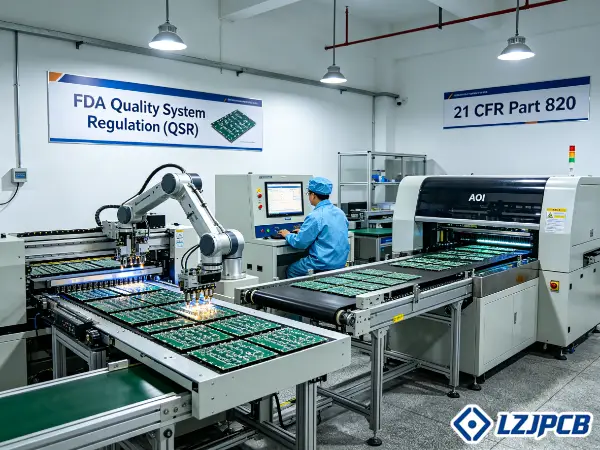
I have managed over 300 PCB projects across 20+ countries, many in medical. I will walk you through the exact steps, questions, and warning signs I use to separate real FDA-ready partners from risky vendors.
What Are the FDA Standards Requirements for Medical Device PCB Manufacturers
Many buyers think "FDA approved" is a simple stamp. It is not. A PCB failure rate of just 0.1% can mean thousands of failed devices and real patient harm.
FDA standards for medical device PCB manufacturers center on 21 CFR Part 820, the Quality System Regulation. The FDA does not approve PCB directly. It requires documented design controls, full traceability, validated processes, and CAPA systems that scale with the device’s risk class.
I see confusion here every week. Let me break down what these rules actually demand from a factory like mine.
FDA Quality System Regulation 21 CFR Part 820 for Medical PCB
The FDA regulates PCBs as part of the finished medical device under 21 CFR Part 820, also called the Quality System Regulation. This rule covers how we design, build, test, and document each board. It is not optional for any device sold in the US.
The FDA sorts devices into three risk classes. Class I has the lowest risk. Class III has the highest. A PCB inside a Class III device like a pacemaker needs Premarket Approval (PMA) with deep documentation and clinical data. A PCB in a Class II device like a blood pressure monitor usually needs a 510(k) submission. That proves the device is equal to one already on the market.
Part 820 also forces design controls. We must show written proof that the design meets its intended use. We track every material back to its source. We keep these records for at least 2 years after device release, often much longer. For a medical board, these controls matter more than price.
FDA Guidance on Printed Circuit Board Assembly for Medical Devices
The FDA expects PCB assembly to follow validated, repeatable processes. This is the core idea. A process must be proven to give the same reliable result every time, not just followed by hand.
For Class III devices, we run process validation. This usually means three back-to-back production runs that pass every quality check, this proves consistency. We also built in heat management. A portable ventilator board, for example, must not overheat during long use.
Material choice is part of FDA guidance too. Implantable boards often use polyimide or ceramic substrates. These resist body fluids and stay stable for years. They cost 3 to 10 times more than standard FR-4, but they are needed for safety. We also use ENIG gold finish over HASL for implants. Gold is inert. It lowers corrosion and biocompatibility risk. Lead-free solder is required under RoHS, with a melting point near 217°C, so we use the right reflow equipment.
Documentation and Traceability Requirements Under FDA Standards
The FDA requires full traceability for every medical PCB. This means we track each board from raw material to finished product. If a recall happens, we must trace the exact lot, supplier, and test data.
Counterfeit parts are a real supply chain risk. Industry data shows component incidents in the 0.5 to 1.5% range. So traceability is a key control point, not paperwork for its own sake. We keep records for a period that fits the device life, but never less than 2 years from release.
Here is what a strong documentation package includes:
| Document Type | Purpose |
|---|---|
| Device Master Record (DMR) | Full build recipe for the device |
| Lot tracking records | Trace each batch to source |
| Material certifications | Prove approved, genuine materials |
| Test reports (ICT, AOI, X-ray) | Show defect detection results |
| CAPA records | Document fixes for problems |
| First article inspection | Confirm the first build is correct |
At LZJPCB, our supply chain team keeps FIFO, ESD-safe, and temperature-controlled storage. We run annual supplier audits with a grade-based elimination system. This keeps the chain clean.
6 Steps to Identify Medical Device PCB Manufacturers with FDA Compliance
You found ten suppliers online. They all claim "FDA compliant." How do you tell the real ones apart before you waste months? You need a clear filter.
To identify FDA-compliant medical PCB manufacturers, follow six steps: search the FDA registration database, verify active status, request compliance declarations, check warning letters, shortlist ISO 13485 holders, and review documentation before sampling.
Each step removes risk. Skip one, and you may end up with a vendor that cannot survive an audit. Here is my exact process.
Step 1: Search FDA Establishment Registration Database for PCB Suppliers
Start with the FDA’s public establishment registration database. Any facility making devices for the US market should register here. This is your first filter. It is free and fast.
Type the company name into the database. If a supplier claims FDA involvement but does not appear, that is a warning sign. Note that PCB makers often register as contract manufacturers, not device owners. So read the listing carefully. The goal is to see if they take the US medical market seriously enough to register at all.
Step 2: Verify Each Manufacturer Active FDA Registration Status
Registration alone is not enough. You must confirm the status is active and current. Companies must renew registration each year. An expired listing means the supplier let it lapse.
Check the registration date and any listed device categories. A supplier active in medical device categories shows real experience. I always tell buyers like Michael in Germany to screenshot this status. Keep it in your sourcing file. It protects you if questions come up later during your own CE or FDA process.
Step 3: Request FDA Compliance Declarations and Audit Reports
Now contact the supplier directly. Ask for a written FDA compliance declaration. Ask for recent internal or third-party audit reports. A serious factory will share these under NDA without delay.
A real partner can show records that align with 21 CFR Part 820. This includes traceability logs, CAPA procedures, and validation data. If they stall or give vague answers, move on. At LZJPCB, we provide these documents early because our ISO 13485 and IATF16949 systems are built for audit readiness.
Step 4: Cross Check Manufacturer Claims Against FDA Warning Letters
The FDA publishes warning letters online, which name companies that failed inspections. Search your shortlisted suppliers here. This step catches problems a sales team will never tell you.
A warning letter is not always a deal-breaker. What matters is the issue and the fix. If a company got a letter and showed strong corrective action, that can be fine. But repeated violations or unresolved issues are a clear stop signal. Honesty in business is a core value for us, so we welcome this kind of check.
Step 5: Shortlist Only Manufacturers with ISO 13485 and FDA Alignment
ISO 13485 is the foundation for FDA quality system work. Keep only suppliers that hold a current certificate. This standard proves a quality system built for medical devices, not just general electronics.
ISO 13485 demands risk management across the full product life. It demands process validation and traceability. It is also widely required to enter the European and Canadian markets. So a supplier with ISO 13485 plus FDA alignment serves both your US and EU needs. This pairing should be your hard minimum.
Step 6: Conduct Pre Audit Documentation Review Before Sampling
Before you order samples, review the supplier’s documentation set. Ask for a sample DMR, a validation protocol, and a traceability example. This pre-audit review saves time and money.
You want to see if their paperwork is real and complete. A good factory also offers a DFM review at this stage. We at LZJPCB catch manufacturability problems early, before they become costly redesigns during certification. Only after this review passes should you spend money on samples. This step turns a hopeful guess into a confident choice.
8 Questions to Ask Medical Device PCB Manufacturers About FDA Standards
A polished website tells you little about real FDA readiness. The right questions expose the truth fast. Ask the wrong ones, and you learn nothing useful.
Ask medical PCB manufacturers eight key questions: recent FDA inspection history, device master record handling, design control process, complaint and CAPA procedures, FEI numbers, component traceability, validation protocols, and subcontractor compliance.
I give these questions to clients before their first supplier call. They cut through sales talk in minutes. Here is what each one reveals.
Has Your Facility Undergone an FDA Inspection in the Past 3 Years
This question shows how exposed the factory is to FDA scrutiny. A facility inspected recently has firsthand experience with FDA expectations. That experience is valuable to you.
Ask for the date and the outcome. If they received a Form 483 with observations, ask how they fixed each item. A clean inspection is great. An inspection with a strong corrective response is also a good sign. No inspection at all is not automatically bad, but it means less proven FDA history.
Do You Maintain Device Master Records for Each Medical PCB Order
The Device Master Record is the full build recipe for a device. A real medical PCB supplier maintains a DMR for each order. This is a core 21 CFR Part 820 requirement.
If a supplier does not know what a DMR is, that is a major red flag. Ask them to describe how they store and update it. The DMR ties together drawings, materials, processes, and tests. Without it, you cannot prove control to the FDA during your own submission.
How Do You Handle FDA Design Control Requirements for Custom PCB
Design controls force documented proof that a design meets its intended use. For custom boards, this matters even more. Ask how the supplier records design inputs, outputs, reviews, and transfers.
At LZJPCB, our team of 50+ engineers runs a DFM process and design transfer documentation. We support up to 28 layers and 112G signal speeds. This depth lets us handle complex medical designs with proper controls. A supplier that relies only on a website order form rarely offers this level of design support.
What Is Your Procedure for FDA Complaint Handling and CAPA
CAPA stands for Corrective and Preventive Action. It is how a factory responds when something goes wrong. Ask the supplier to walk you through one real example, with the names removed.
A strong CAPA process finds the root cause, fixes it, and stops it from returning. Many use a DMAIC model for continuous improvement. If a supplier cannot describe their CAPA flow, they likely cannot manage quality at the medical level. This procedure protects your brand from repeat failures.
Can You Provide FDA Establishment Identifier Numbers for Verification
The FDA Establishment Identifier (FEI) number lets you verify the facility independently. Ask for it directly. A compliant supplier shares it without hesitation.
You can use this number to confirm the registration and inspection history I mentioned earlier. A refusal to share the FEI, or an inability to find it, is a serious warning. It often means the supplier is not truly registered for the US medical market. This single number ties their claims to public, checkable records.
How Do You Ensure Component Traceability to Meet FDA Standards
Component traceability tracks every part back to its source. Ask how the supplier sources parts and how they block counterfeits. This is critical given known supply chain risks.
Our 20+ person supply chain team buys only from original makers and tier-1 agents. Every part is 100% genuine and traceable. We run IQC inspection on incoming goods. We store parts FIFO with ESD and climate control. Ask your supplier for the same level of detail. Vague answers here put your patients at risk.
What Validation Protocols Do You Follow for FDA-Regulated Medical PCB
Validation proves a process gives consistent, reliable results. Ask which protocols they use and for which device classes. For Class III work, expect three consecutive passing production runs.
A good supplier validates reflow profiles, solder paste printing, and test steps. They keep calibration logs and first article inspections. These records become part of your design history file. If a supplier cannot explain their validation approach, they cannot support a high-risk medical product.
Do Your Subcontractors Also Comply with FDA Quality System Regulation
A weak subcontractor can break your whole compliance chain. Ask whether subcontractors follow the same quality system rules. A real partner controls and audits its suppliers.
We run annual supplier audits with a grade-based elimination system. We drop the lowest performers. This keeps our chain strong. Ask your supplier how they qualify and monitor their own vendors. If they cannot answer, their FDA claims stop at their front gate. True compliance must reach every link.
5 Red Flags When Evaluating Medical Device PCB Manufacturers for FDA Standards
Some warning signs are easy to miss when a supplier sounds confident. But these red flags predict trouble. Ignoring them can cost you a recall.
Five red flags signal an unsafe medical PCB supplier: claiming "FDA approval" instead of compliance, failing to provide an FDA registration number, having no separate medical line, refusing a quality agreement, and lacking design transfer documentation.
I have seen each of these sink a project. Spot them early and walk away before you lose time and money. Here is what to watch for.
Red Flag 1 Claims FDA Approval Instead of FDA Compliance
The FDA does not approve PCB manufacturers, it approves or clears finished devices. A supplier who claims "FDA approved" for their factory does not understand the rules. That alone is a warning.
The correct term is FDA-compliant, meaning aligned with 21 CFR Part 820. This may sound like wordplay. It is not. A supplier that misuses this term may make other compliance mistakes that hurt your submission. Real experts speak the right language because they live inside these rules.
Red Flag 2 Unable to Produce FDA Registration Number on Request
If a supplier cannot give an FDA registration or FEI number, be careful. A registered facility knows its number. A delay or excuse here suggests they are not truly registered for the US medical market.
This is a quick test. Ask, and watch the response. A serious factory replies fast and points you to the public record. A vague or shifting answer means their FDA story may not hold up. Do not order samples until this is clear.
Red Flag 3 No Separate Medical Device Production Line or Controls
Medical boards need tighter controls than consumer electronics. A supplier with no dedicated line or special controls cannot guarantee the cleanliness and consistency you need. This raises contamination and mix-up risk.
Cleanrooms matter here. Our FPC factory runs a Class 100K cleanroom. Medical PCB lines often meet ISO 14644-1 Class 7 or Class 8. Ask to see their setup. A factory that builds medical and toy boards on the same uncontrolled line is a poor fit for FDA work.
Red Flag 4 Refuses to Sign FDA Compliant Quality Agreement
A quality agreement sets out who is responsible for what. It covers regulatory duties, IP protection through NDAs, and defect limits like under 100 ppm. A supplier who refuses to sign one is hiding from accountability.
This document protects you. A defect rate under 100 ppm means no more than 1 bad board per 10,000. A real partner is happy to commit in writing. Win-win collaboration is a core value for us, so we sign clear agreements. A refusal tells you the supplier will not stand behind its work.
Red Flag 5 Cannot Demonstrate Design Transfer Documentation Process
Design transfer moves a design from engineering into production with full records. A supplier who cannot show this process will struggle with FDA design controls. Your design history file depends on it.
Ask them to describe how a design moves from your files to their factory floor. They should track every step. We document this transfer as part of our DFM and engineering review. A supplier that just "starts building" from your Gerber files, with no transfer records, cannot support a regulated medical product.
How to Verify a Manufacturer Actual FDA Compliance Beyond Certificates
Certificates can be old, narrow, or even forged. A paper file does not prove a factory runs clean today. You need to dig past the documents.
To verify actual FDA compliance beyond certificates, search FDA 483 observations, request inspection reports with supplier permission, conduct an on-site audit using an FDA checklist, and order sample PCBs while auditing the lot documentation against FDA standards.
This is where careful buyers separate from hopeful ones. Real proof comes from records and your own eyes. Here is how to confirm the truth.
Search FDA 483 Inspection Observations for Shortlisted Manufacturers
A Form 483 lists problems FDA inspectors found at a facility. Search the public 483 data for your shortlisted suppliers. This shows real issues, not marketing claims.
Read what the observations covered. Were they minor paperwork gaps or serious process failures? A factory with no 483 history may simply lack US inspection exposure. But a factory with serious, repeated 483 items is a clear risk. Use this to rank your shortlist by real-world performance.
Request FDA Establishment Inspection Reports with Supplier Permission
You can request an Establishment Inspection Report (EIR) with the supplier’s cooperation. This report gives a fuller picture than a single 483. Ask the supplier to support this request.
A confident factory agrees, because the report shows their corrective actions and current state. A reluctant factory may be hiding past problems. The EIR helps you see how they responded to FDA feedback over time. Cooperation here is itself a good sign of a trustworthy partner.
Conduct On-Site Audit Using FDA Quality System Checklist
Nothing replaces visiting the factory. An on-site audit lets you check cleanrooms, equipment, and team skills in person. Bring an FDA quality system checklist and work through it.
Look for Laser Direct Imaging for fine traces and microvias. Look for automated test stations, X-ray, and AOI. Check cleanroom particle control. Watch how staff handle records. We welcome client visits across our bases in Shenzhen, Jiangxi, and Indonesia. A factory that hides its floor is hiding something. A factory proud of its lines invites you in.
Order Sample Medical PCB and Audit Lot Documentation Against FDA Standards
The final test is a real order. Order sample boards and then audit the paperwork that comes with them. Match every record to FDA expectations.
Check the lot tracking, material certs, and test reports. For Class II and III work, functional testing should cover 100% of units, not a sample. Verify the ICT, AOI, and X-ray results match the boards you hold. We run 100% electrical test plus AOI dual inspection. If the sample documentation is clean and complete, you have found a real partner. If not, you learned this before mass production, when it was cheap to walk away.
Medical Device PCB Manufacturers Certification Hierarchy Under FDA Standards
Buyers often drown in acronyms: ISO, IEC, IPC, UL. Which one matters most? Treating them all as equals leads to wrong choices.
The medical PCB certification hierarchy starts with ISO 13485 as the quality system foundation, then IEC 60601 for device safety, IPC Class 2 or 3 for assembly workmanship, and UL marking for material and equipment safety in FDA-regulated devices.
Each layer plays a different role. FDA compliance alone does not cover board workmanship. Here is how the pieces fit together.
ISO 13485 as the Foundation for FDA Quality System Compliance
ISO 13485 is the base layer for all medical device quality work. It defines a quality management system built for medical devices. FDA’s 21 CFR Part 820 is similar, so ISO 13485 maps well to it.
This standard mandates risk management across the whole product life. It requires process validation, so steps are proven, not just followed. It requires traceability, so every material is tracked. A single device sold in both the US and EU must meet both FDA QSR and ISO 13485. They are alike but not identical, so you need both. We hold ISO 13485 along with ISO 9001 and IATF 16949.
IEC 60601 Safety Standards Required for FDA-Cleared Medical Devices
IEC 60601-1 is the core safety standard for medical electrical equipment. It covers shock, mechanical hazards, and patient safety. IEC 60601-1-2 covers EMC, so devices do not disturb each other.
This matters for hospital safety. A portable ECG machine must not interfere with an MRI. EMC emissions testing runs from 150 kHz to 80 MHz. For patient-connected CF parts, leakage current stays at or below 10 μA under normal conditions. The standard also sets dielectric strength tests and creepage distances.
| Requirement | Example Value |
|---|---|
| EMC emissions range | 150 kHz – 80 MHz |
| Patient leakage (CF, normal) | ≤ 10 μA |
| Patient leakage (CF, single fault) | ≤ 50 μA |
| Dielectric test (250V, reinforced, 1 MOPP) | 2500 Vrms, 60 sec |
| Clearance (250V, reinforced, 2 MOPP) | ≥ 4.0 mm |
Meeting IEC 60601 may need extra PCB layers for EMI shielding. That can raise costs, but it protects patients.
IPC Class 3 or Class 2 Requirements for Different Medical Device Categories
IPC standards set the workmanship rules for electronic assembly. Class 2 fits general reliable products. Class 3 fits high-reliability and life-critical devices. The right class depends on your device category.
Implantable and life-supporting boards need IPC-A-610 Class 3. This is the highest reliability standard. Class 3 still allows defined acceptance limits. For example, it permits up to 25% void per BGA solder ball, not zero. So Class 3 means tightly controlled, not perfect. We build to Class 3 for life-critical medical work and confirm the right class with you during DFM review.
UL Marking for Medical PCB Used in FDA-Regulated Equipment
UL marking shows material and equipment safety. Healthcare buyers often ask for it as a mark of trust. Medical laminates usually carry a UL 94 V-0 flammability rating.
Note that UL 60601-1 has been withdrawn. The current US standard is ANSI/AAMI ES60601-1, based on IEC 60601-1. It references flammability per UL 94, where V-0 is common but not required for every PCB. We hold UL and CUL certification. We use UL/RoHS traceable A-grade laminates from Shengyi, KB, and Jinguo. Ask your supplier to confirm the exact UL status of the materials they plan to use.
Common Mistakes When Sourcing Medical Device PCB Manufacturers for FDA Standards
Even careful buyers fall into the same traps. These mistakes feel safe in the moment but cause delays and recalls later. I see them again and again.
The most common sourcing mistakes are confusing "FDA registered" with "FDA compliant," accepting ISO 13485 alone without FDA-specific documents, skipping verification of FDA status before production, and assuming all medical PCBs need identical FDA controls.
Avoiding these four errors will save you months. Let me explain each one and how to dodge it.
Mistake 1: Confusing FDA Registered with FDA Compliant Manufacturers
Registration and compliance are not the same thing. Registration just means the facility told the FDA it exists and makes devices. Compliance means it actually follows 21 CFR Part 820 in practice.
A factory can be registered and still run weak processes. Do not stop at the registration number. Dig into traceability, CAPA, validation, and audit readiness. I have seen buyers pick a "registered" supplier and then fail their own audit because the factory was not truly compliant. Registration is step one, not the finish line.
Mistake 2: Accepting ISO 13485 Alone Without FDA-Specific Documentation
ISO 13485 is essential, but it is not the whole story. FDA QSR is similar yet not identical. A supplier may hold ISO 13485 and still lack the FDA-specific records you need for a US submission.
Ask for documents that map directly to 21 CFR Part 820. This includes design controls, DMR, and US-style traceability. Do not assume the certificate covers everything. A real partner shows both ISO 13485 and FDA-aligned documentation. Treat the certificate as a strong start, then confirm the FDA-specific layer on top.
Mistake 3 Skipping Verification of Manufacturer FDA Status Before Production
Some buyers trust claims and jump straight to production. This is a costly gamble. If the FDA status is wrong, you may have to redo work and resubmit. That can add 6 to 18 months to your timeline.
Always verify status before you commit to mass production. Check the registration, search 483 records, and review documentation first. The verification takes days. A failed submission takes many months. The math is simple. Verify early, and you protect your whole launch schedule.
Mistake 4: Assuming All Medical PCBs Need the Same FDA Controls
Not every medical board needs the same controls. The FDA scales requirements by risk class. A Class I device needs less than a Class III implant. Over-specifying wastes money. Under-specifying risks patient safety and rejection.
A Class III board needs PMA, full validation, and three passing runs. A Class II board often needs a 510(k). Match the controls to your device class. A good supplier helps you find the right level. We review your device class during DFM and recommend the correct controls, materials, and finishes for that exact risk level.
Frequently Asked Questions About Finding FDA Compliant Medical Device PCB Manufacturers
Buyers send me the same hard questions over and over. The answers are not always obvious, and wrong assumptions cause real problems. Let me clear up the most common ones.
The FDA does not certify or approve PCB manufacturers; it regulates finished devices. Non-US factories can comply with FDA standards. ISO 13485 holders undergo annual surveillance audits with a 3-year recertification cycle, and lost compliance during production demands immediate corrective action.
These questions come up in almost every project I run. Here are clear, direct answers based on real experience.
Does the FDA Certify or Approve Medical PCB Manufacturers
No. The FDA does not certify or approve PCB manufacturers as a stamp on the factory. The FDA regulates finished medical devices. It expects the makers behind those devices to comply with 21 CFR Part 820.
So a factory cannot truly be "FDA approved." It can be FDA registered and FDA compliant. When a supplier claims approval of their plant, they misuse the term. Look instead for proven compliance with the Quality System Regulation. That is what protects your device submission.
Can a Non-US Medical Device PCB Manufacturer Comply with FDA Standards
Yes. A non-US manufacturer can fully comply with FDA standards. The FDA inspects foreign facilities and accepts compliant suppliers worldwide. Location does not block compliance. Process and documentation do.
As a China-based factory, we build to 21 CFR Part 820 alignment for our medical clients. We hold ISO 13485, ISO 9001, and IATF 16949. We serve clients in the USA, Europe, Brazil, and Russia. The key is the same for any country: real traceability, validation, and audit-ready records.
What Is the Difference Between FDA 510k Clearance and FDA QSR for PCB
These two cover different things. FDA QSR (21 CFR Part 820) governs how the device and its PCB are made. It is about process and quality systems. A 510(k) is a market clearance for the finished device.
A 510(k) shows the device is substantially equivalent to a legal device already on the market. It may include reliability test data from the PCB. So, QSR is the ongoing manufacturing rulebook. The 510(k) is the gate to enter the US market for a Class II device. Your PCB supplier supports both with proper records.
How Often Do Medical Device PCB Manufacturers Need FDA Audits
There is no fixed calendar for FDA inspections. The FDA inspects based on risk, history, and other factors. A high-risk facility may see more frequent visits. So FDA audit timing varies.
ISO 13485 is different and more predictable. Certified manufacturers undergo surveillance audits, usually once a year. Full recertification runs on a 3-year cycle. Internally, we audit our own suppliers every year with a grade-based elimination system. This keeps quality steady between any external visits.
What Happens If My PCB Manufacturer Loses FDA Compliance During Production
This is a serious risk that needs a fast response. If a supplier loses compliance mid-production, you must act at once. Stop affected lots, trace them through your records, and assess patient risk.
This is exactly why traceability and a quality agreement matter so much. With full lot tracking, you can isolate the problem batches quickly. A strong supplier launches a CAPA to fix the root cause. The best protection is choosing a stable, proven partner from the start. A reliable medical PCB supplier is a long-term partner, not just the lowest bidder, because compliance and support drive product success far more than board price alone.
Conclusion
Finding an FDA-ready medical PCB partner means verifying ISO 13485, FDA alignment, full traceability, and Class 3 capability. Choose a proven long-term partner, not the cheapest vendor.